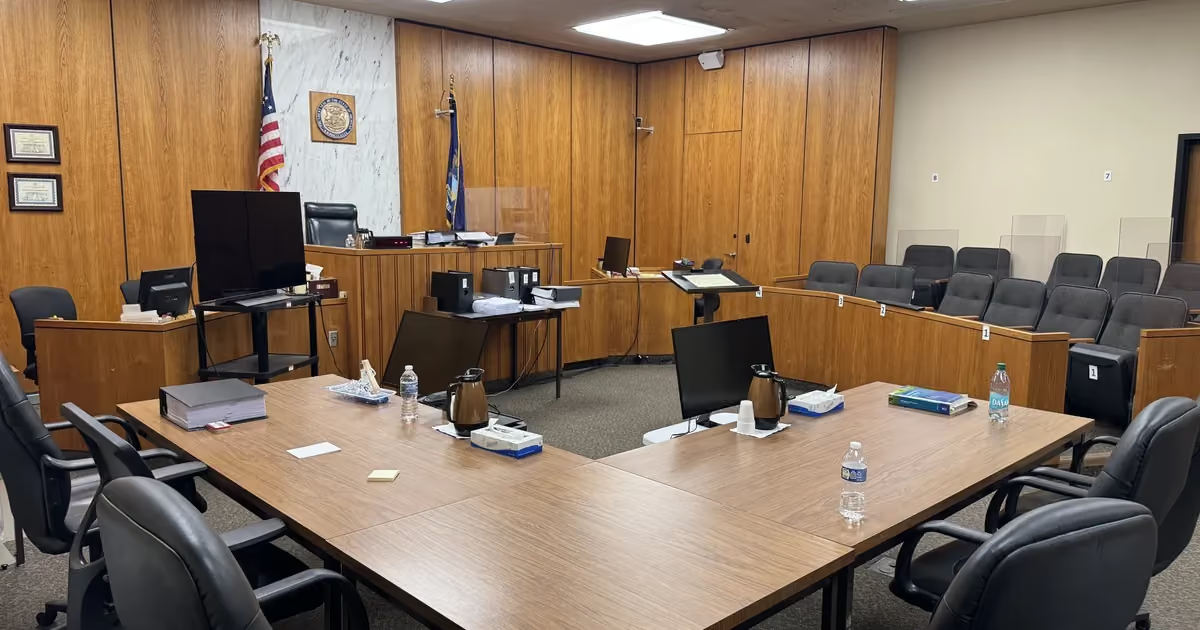

Remote Testimony & Hybrid Trial Support
Remote and hybrid witness setups with redundant connectivity and clean, record-ready audio.
Remote and hybrid witness setups with redundant connectivity and clean, record-ready audio.
More litigation teams are asking the same question before trial: can our expert witness testify from another state? Hybrid proceedings have become a regular part of modern litigation, and courts across Michigan and beyond have adapted accordingly.
Whether the goal is a fully remote setup or a hybrid courtroom with in-person and remote participants, preparation is what separates a smooth proceeding from a stressful one.
Hybrid trial support combines in-person courtroom activity with remote participation, a witness appearing by video while the judge, jury, and attorneys remain in the courtroom, or an expert joining from out of state. It requires secure video connections, courtroom display integration, audio routing, and exhibit sharing that all work together.
Zoom trial
Fully remote. Every participant joins from a separate location, with no physical courtroom component.
Hybrid support
Keeps a physical courtroom while select participants, such as a witness or expert, join remotely.
A dropped call during expert testimony is not a minor inconvenience. It can affect how a jury perceives credibility.
Yes, in many cases. Requirements vary by court and case, so attorneys should confirm the specific rules that apply to their proceeding.
Professional-grade cameras, microphones, courtroom display systems, and backup connectivity. Personal devices and consumer video tools are generally not sufficient for courtroom use.
A properly prepared setup includes backup connectivity and equipment, and a technician monitoring the session in real time can respond immediately to minimize disruption.
Connected & redundant
Should expert witness depositions be recorded differently from other depositions?
In many cases, yes. Expert depositions often carry more weight at trial, and the recording approach should reflect that.
An expert's credibility often comes through as much in how they're presented as in what they say, so it's worth treating that recording with extra care from the start.
What happens if a remote witness loses their internet connection during testimony?
This is one of the most common fears attorneys have about remote testimony, and it's a fair one. Connection issues happen, even with good planning. What matters is having a system built to handle it without derailing the proceeding.
A well-prepared remote testimony setup typically includes:
The difference between a minor hiccup and a real problem usually comes down to preparation. Redundant systems and a calm, practiced response mean testimony can resume quickly, without the disruption becoming part of the story.
Can remote expert witnesses be displayed alongside exhibits during testimony?
Yes. This is one of the more technically involved things we do, and it has become much more common since remote testimony became standard practice.
Done well, jurors should not even notice the added complexity. It should feel as natural as an in-person witness.
Backups, redundancy, calm. The mobile office goes where your case goes.
John is calm, prepared, and invisible in the best way. The technology simply works, every deposition, every trial day.
Laura Johnson, Smith Haughey Rice & Roegge
From remote witnesses to courtroom playback, everything ran without a hitch. I never had to think about the equipment once.
Farah Israel, Kitch Attorneys & Counselors
The most reliable trial technician we have worked with. Redundant systems meant we never lost a minute of courtroom time.
Eric Ramar, Ottenwess Law, PLC
Tell us about your case. We'll bring the technology, the preparation, and the calm.