Articles

Articles in This Category

FAQ

FAQs in This Category

Do courtroom technology requirements vary between Southeast Michigan courts?

They do, sometimes more than attorneys expect. Wayne, Oakland, Macomb, and Washtenaw County courthouses each have their own built-in technology, courtroom layouts, and IT policies. Some courtrooms come equipped with modern displays and integrated systems, while others require bringing in most of the equipment from scratch. Knowing these differences ahead of time, rather than discovering them on the morning of trial, is part of what makes preparation so important across different venues.

Do you test courtroom audio and video equipment before trial begins?

Always. Equipment testing happens well before opening statements, not after something goes wrong. This typically includes confirming compatibility with the specific courtroom's existing systems, checking microphone levels throughout the room, testing playback on every screen, and running a full walkthrough of the day's presentation materials. Courthouses vary widely in their built-in technology, so testing in advance means fewer surprises once the trial is underway.

Should expert witness depositions be recorded differently from other depositions?

In many cases, yes. Expert depositions often carry more weight at trial, and the recording approach should reflect that.

  • Higher production quality helps maintain credibility with jurors
  • Additional camera angles can capture exhibits, models, or demonstratives the expert references
  • Careful audio setup matters more when technical terminology needs to be clearly understood
  • Extra attention to lighting and framing keeps the focus on the expert's testimony

An expert's credibility often comes through as much in how they're presented as in what they say, so it's worth treating that recording with extra care from the start.

How are deposition clips edited for use during trial?

Editing deposition footage for trial is less about cutting a highlight reel and more about precision. Every clip needs to match the transcript exactly and hold up if opposing counsel objects to how it was used.

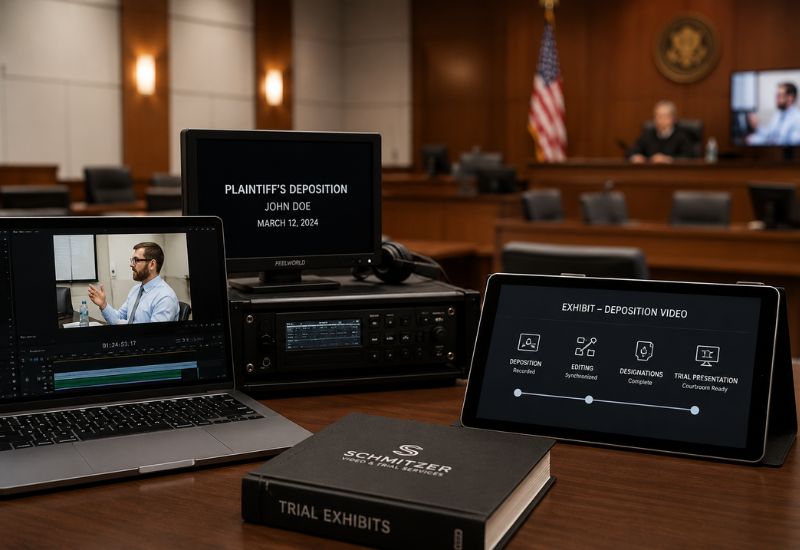
Clips are synced to the certified transcript so the video and text align word for word. Objections and rulings are tracked so only admissible portions make it into the final cut. From there, clips are organized by topic or witness so the attorney can pull up the exact moment needed without searching through hours of footage during trial.

What equipment is typically used to record a professional video deposition?

Professional video depositions require more than a webcam and a quiet room. Broadcast-quality equipment ensures the recording holds up if it's ever played back in court, sometimes years after the deposition took place.

A properly equipped legal videographer typically brings:

  • High-definition cameras, often with a backup camera running simultaneously
  • External microphones for both the witness and attorneys, since built-in mic audio rarely holds up in a courtroom setting
  • Professional lighting to keep the witness clearly visible without harsh shadows or glare
  • Time-stamping equipment or software that embeds a running clock into the recording
  • Backup recording devices and extra batteries, since a dead battery mid-testimony isn't an acceptable excuse
  • Reliable playback and export tools to deliver footage in whatever format the court or opposing counsel requires

The equipment itself isn't flashy. What matters is redundancy. If one camera or mic fails, a second system should already be running so the deposition never has to stop.

How does picture-in-picture recording improve video depositions?

Picture-in-picture lets you see more than one thing at once, and in a deposition, that extra context can matter a lot.

  • It allows the witness's face and reaction to be shown alongside a document, exhibit, or video clip they are being questioned about.
  • Jurors and attorneys can watch body language and reaction in real time rather than losing that context while looking at a static exhibit.
  • It is particularly valuable for impeachment testimony, where the witness's reaction to a document can be as telling as their verbal answer.

It is a small technical detail that can make a real difference in how persuasive a deposition clip is later at trial.

Can you synchronize deposition videos after they have already been recorded?

Yes, in most cases. Video-transcript synchronization is a service we offer independently of the original recording. We take your existing deposition video and the certified transcript and sync them together, timestamp by timestamp.

This makes it possible to jump directly to a specific line of testimony during trial instead of scrubbing through hours of footage. It is especially useful for impeachment moments, where speed and accuracy matter.

If you have raw footage sitting in a file somewhere from an older deposition, it is not too late to get it trial-ready.

Get Started

Let's Prepare Your Team for Trial

Tell us about your case. We'll bring the technology, the preparation, and the calm.