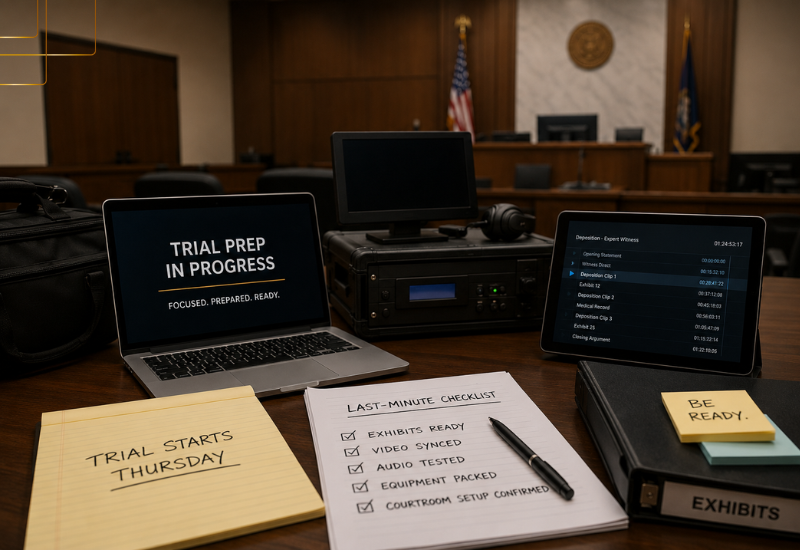

Why We Bring a "Mobile Office" to Every Trial
Picture this. A witness is on the stand. Counsel pulls up a critical exhibit, and the screen goes black. The projector won't sync. The laptop freezes. Every second of...
Read articleHow a trial technician actually works a case, day to day.
Do you work directly with attorneys, court reporters, or both?
Both, and honestly, coordination between all parties is a big part of what makes a deposition or trial run smoothly.
Litigation is a team effort, and we see our role as making sure the technology side of that team never becomes the weak link.
What is the difference between a legal videographer and a trial technician?
Great question, and one we get a lot. The roles overlap but they are not the same job.
A legal videographer focuses on recording depositions: setting up cameras, capturing clean audio, and syncing video to the transcript so it can be used later in trial.
A trial technician handles the courtroom itself: running exhibits, managing playback, coordinating monitors and projectors, and making sure everything displays correctly in real time in front of a judge and jury.
Think of it this way: the videographer captures the evidence, and the trial technician presents it. We do both, which means your case has continuity from deposition day all the way through the verdict, with no handoff, no gaps, and no relearning your case at the last minute.
Tell us about your case. We'll bring the technology, the preparation, and the calm.